The first thing anyone saw was the dark ground.
The field had recently burned, leaving the earth quiet and almost empty.
There were no tall grasses to offer shade.
No thick bushes where a mother cat could hide her young.
Only blackened soil, scattered stones and the remains of what had once grown there.
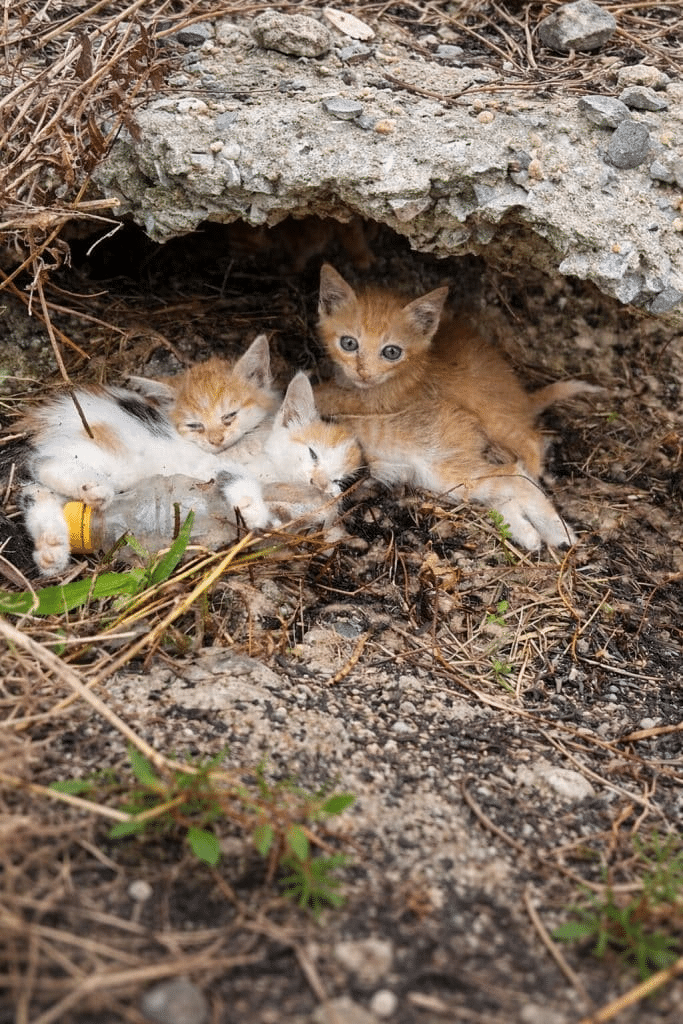
Then, beneath a small hollow beside a rock, something moved.
Four tiny kittens were lying close together.
Their bodies were weak.
Their breathing was faint.
Some were barely responsive.
They had found the only shelter available, pressing against one another in a place that could offer little protection.
They had survived the fire around them.
But now exhaustion, dehydration and exposure were quietly taking what little strength remained.
Four Small Lives Hidden in the Ashes
No one knew how long the kittens had been there.
Perhaps their mother had carried them into the rocky hollow before the field changed.
Perhaps she had gone searching for food and had been unable to return.
Whatever had happened, the kittens were now alone.
They were too young to find water.
Too weak to search for food.
And far too vulnerable to survive another long period without help.
When the rescuer knelt beside them, the kittens barely reacted.
There were no obvious external injuries from the burned surroundings.
But their condition told a different story.
Their bodies were exhausted.
Their mouths were dry.
Their energy had faded so deeply that even lifting their heads seemed difficult.
One kitten remained almost completely still.
Another moved only slightly when touched.
The rescuer understood that simply carrying them away would not be enough.
They needed support immediately.
The First Care Given in the Open Field
There was no clinic nearby.
No warm recovery room.
Only the field, the kittens and the limited supplies the rescuer had brought.
So care began where they were found.
Each kitten was checked gently.
The rescuer watched their breathing and looked for any sign of injury that might make movement unsafe.
Small amounts of water were offered carefully.
The goal was not to give too much too quickly.
Their fragile bodies needed time to respond.
A little moisture touched their mouths.
A small amount of suitable food followed when they were able to accept it.
The rescuer moved from one kitten to the next.
No one was forgotten.
Every small response mattered.
A swallow.
A slight movement.
Eyes opening for a moment.
These were not dramatic signs.
But in a place where the kittens had been fading quietly, they offered the first reason to hope.
VIDEO: Four Weak Kittens Found in a Burned Field Receive Emergency Care and a Second Chance
When Their Breathing Became the Greatest Concern
As the rescuer continued examining them, it became clear that weakness was affecting more than their movement.
Their breathing was shallow.
Their bodies did not have enough energy to recover without additional support.
So the rescuer acted immediately.
Oxygen was provided there in the field.
The kittens were positioned carefully so their breathing could be observed.
The rescuer remained beside them, watching each small rise and fall of their chests.
Minutes passed slowly.
There was no rushing.
No assumption that one brief effort would be enough.
The kittens needed calm, steady support.
The rescuer stayed focused, adjusting the care as their bodies responded.
For a long time, the field remained quiet except for the sound of equipment and the faint breathing of four tiny animals.
Then something began to change.
One kitten moved its head.
Another became slightly more responsive.
Their breathing appeared steadier.
They were still fragile.
But they were no longer fading without anyone beside them.
Stable Enough to Leave the Field
Only after the kittens had responded to the emergency support did the rescuer prepare to move them.
Transportation itself had to be handled carefully.
Their bodies were weak.
Their temperature needed attention.
And unnecessary stress could undo the small progress they had made.
The kittens were placed together so they could continue sharing warmth.
Their breathing was monitored during the journey.
The burned field slowly disappeared behind them.
For the first time, the four kittens were being carried toward a place designed for healing.
They did not know where they were going.
They only knew that gentle hands had lifted them from the hard ground.
Warmth Replaces the Cold Earth
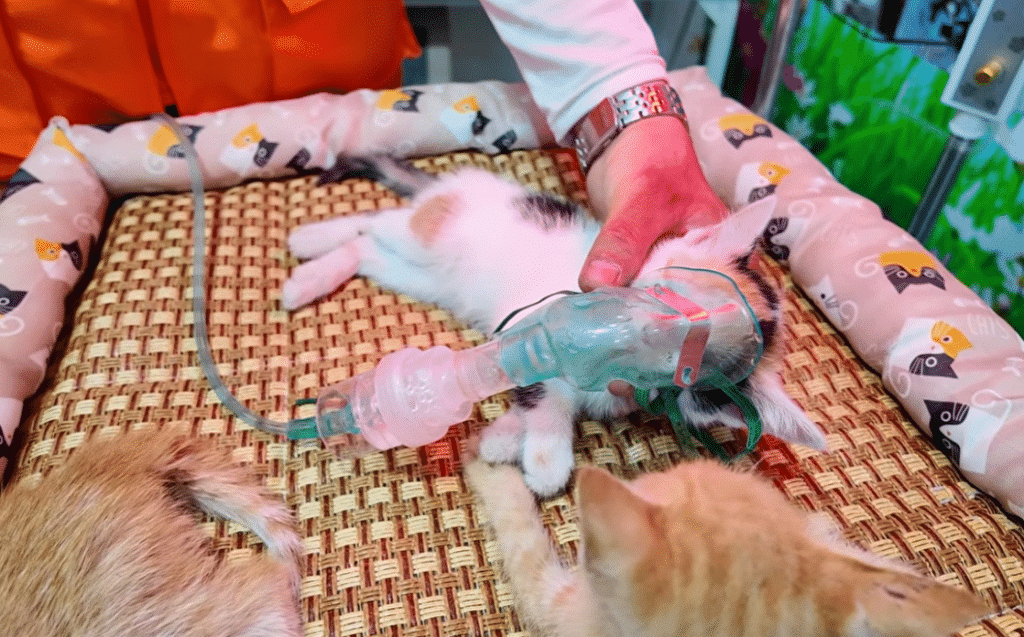
At the care center, the kittens were moved into a protected recovery space.
Gentle warmth surrounded them.
Instead of lying against stones and ash, they rested on clean, soft bedding.
Heat support helped their bodies return gradually toward a safer temperature.
Their eyes were cleaned.
Their noses were cleared carefully.
Every kitten was checked again from head to paw.
The caregivers looked for signs of discomfort, breathing difficulty and dehydration.
Food and fluids were offered according to what each small body could manage.
Some responded more quickly than others.
One kitten remained deeply tired.
Another began reacting to the voices nearby.
But they were together.
They were warm.
And they were being watched closely.
For animals found in such a fragile condition, this attention could make all the difference.
The Quiet Work of Supportive Care
The first hours at the center were not about play or exploration.
They were about stability.
Keeping the kittens warm.
Helping them breathe comfortably.
Making sure their bodies received enough hydration and nourishment.
Cleaning their faces so they could breathe and rest more easily.
Caregivers checked them repeatedly.
They noticed every change.
A kitten shifting beneath the blanket.
A stronger response to touch.
A slightly better appetite.
A steadier breathing pattern.
These moments may have seemed small.
But recovery is often built from small signs appearing one after another.
The kittens had spent so much energy simply staying alive.
Now their bodies could begin using that energy to heal.
Strength Returning Little by Little
As time passed, the four kittens became more responsive.
Their eyes remained open for longer periods.
Their heads lifted when someone approached.
Their movements became more controlled.
One kitten began searching for food instead of waiting for it to be brought directly to its mouth.
Another crawled closer to its siblings, seeking warmth and familiarity.
The change was gradual.
There was no single moment when everyone could say the danger had completely passed.
But the direction was different now.
The kittens were no longer becoming weaker in an empty field.
They were gaining strength in a place filled with care.
Their appetites slowly returned.
Their breathing became steadier.
The small bodies once almost motionless beneath the rock began showing signs of curiosity again.
The First Glimpse of Their Personalities
As their condition improved, the kittens began revealing who they were beneath the exhaustion.
One was more eager to move.
Another preferred resting close to the others.
A third responded quickly whenever food appeared.
The fourth watched quietly from the warmth of the blanket.
These tiny differences mattered.
They showed that the kittens were becoming more than patients.
They were beginning to experience the world again.
There were new sounds to hear.
Gentle hands to recognize.
Clean blankets to explore.
Meals arriving regularly.
The field had taught them only uncertainty.
The care center was beginning to teach them something else.
Safety.
No Longer Facing the Journey Alone
The kittens still required close monitoring.
Their bodies had experienced significant stress.
Recovery would need time, consistency and continued attention.
But the burden was no longer theirs alone.
Caregivers were watching their breathing.
Preparing their meals.
Keeping them warm.
Cleaning their eyes and noses.
Responding whenever one kitten seemed weaker than the others.
The four siblings could finally rest without relying only on one another for survival.
They still curled together.
They still sought comfort in the warmth of familiar bodies.
But now compassionate people were protecting all of them.
A Different Future Begins to Take Shape
Each day brought another small sign of improvement.
A few steadier steps.
A stronger appetite.
More awareness of the room around them.
The kittens were still young and vulnerable, but their future no longer looked as uncertain as it had beneath the rock.
They had been found at a moment when timing mattered.
A little later, and their bodies may have had even less strength to respond.
Instead, someone reached them.
Someone began care in the field.
Someone stayed through the long minutes of breathing support.
And someone carried them toward warmth.
That chain of compassionate decisions opened a path forward.
The Importance of Arriving in Time
Animal rescue is not always a single dramatic action.
Sometimes it is a series of quiet choices made quickly and carefully.
Stopping in a damaged field.
Looking beneath a rock.
Recognizing that four still bodies are not beyond help.
Offering water in small amounts.
Supporting weak breathing.
Waiting until movement is safe.
Then continuing care long after the first emergency has passed.
Each step gave the kittens something they could not create for themselves.
Time.
Strength.
And another opportunity to respond.
Four Small Lives Beyond the Ashes
The burned field will always be where their story began.
It was the place where they were found huddled together, too weak to search for anything better.
But it will not be the only place their lives are remembered.
They are now known through the warmth surrounding them.
The meals helping them grow stronger.
The careful hands cleaning their small faces.
The people watching over every breath.
Their journey is still continuing.
There may be more days of treatment and observation ahead.
But they are no longer hidden.
No longer alone.
No longer waiting in silence for help that may never come.
A Gentle Reminder About Timely Kindness
Sometimes compassion begins with noticing what others might miss.
A small hollow beneath a rock.
A faint movement against dark ground.
Four tiny lives lying close together in a place that appears empty.
The rescuer did not know exactly what the outcome would be.
He only knew that the kittens needed help now.
So he stayed.
He offered what support he could.
And he carried them toward people who could continue the work.
Because of that, four fragile kittens found more than emergency care.
They found warmth.
Protection.
And the possibility of growing into the playful young cats they had not yet had the chance to become.
They were found surrounded by the remains of a burned field.
But their story did not end in the ashes.
It began again there—one breath, one small response and one compassionate decision at a time.