The first thing anyone heard was a small cry near the water.
It was faint.
Tired.
But persistent enough to carry across the quiet surroundings.
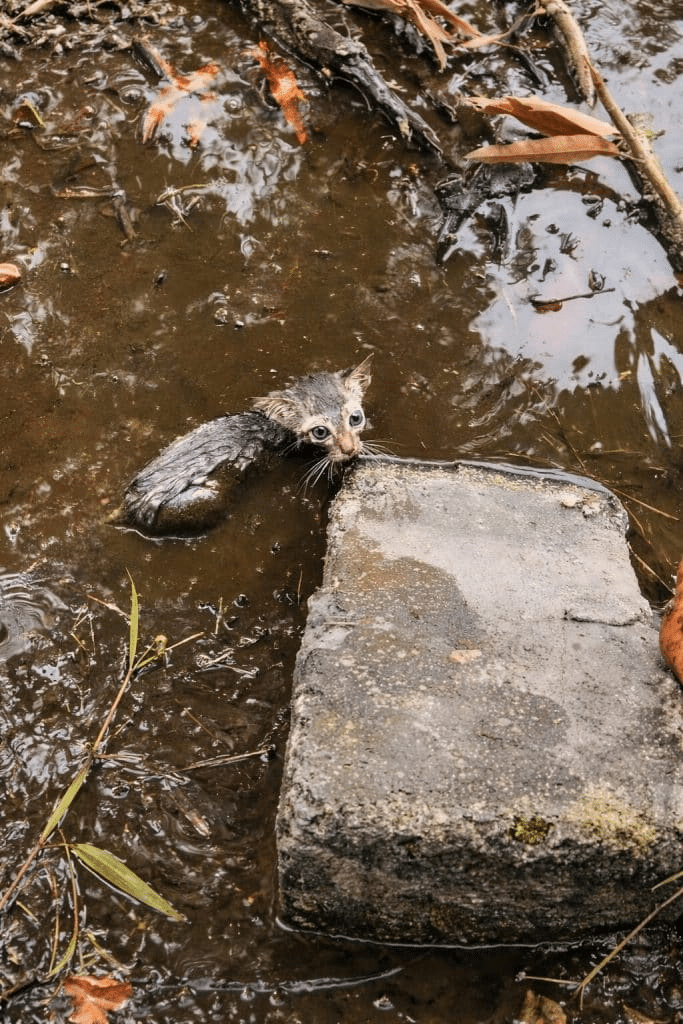
When a man followed the sound, he found a tiny kitten struggling at the muddy edge.
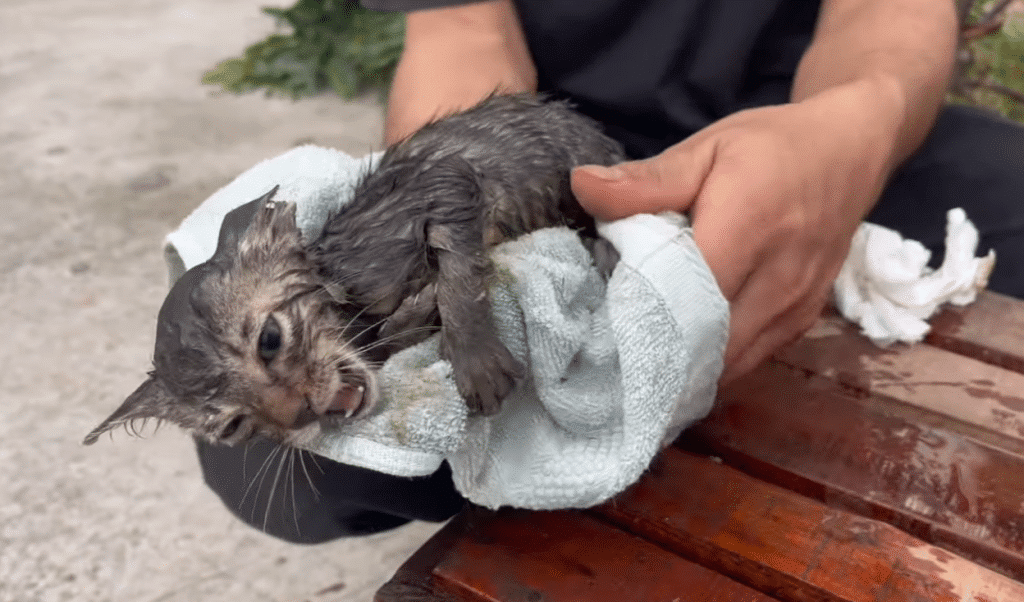
The kitten’s fur was soaked.
Mud covered much of his body.
His small paws could barely hold him upright on the slippery ground.
He did not have the strength to travel far.
He could only remain where he was and continue calling.
Hoping that somewhere nearby, someone would listen.
Someone did.
A Small Life Struggling Against the Cold Ground
No one knew how the kitten had reached the water’s edge.
Perhaps he had wandered away from his mother.
Perhaps he had slipped into the mud while searching for shelter or food.
Or perhaps he had been alone for much longer than anyone realized.
Whatever had happened, the wet ground had become a trap.
Each attempt to move caused his paws to sink or slide.
His heavy fur clung tightly to his body.
The cold moisture surrounding him slowly drained the little strength he had left.
For an adult animal, the distance to dry ground might have seemed small.
For this kitten, it was overwhelming.
He lifted his head and cried again.
His voice was the only way he could ask the world not to leave him there.
The Man Who Chose to Follow the Sound
The man nearby could have mistaken the crying for a distant bird or another ordinary sound from the water.
Instead, he stopped.
He listened more carefully.
Then he began looking along the muddy bank.
That simple decision led him to the kitten.
The animal looked even smaller up close.
His body was tense from the cold.
Mud covered the soft coat that should have helped keep him warm.
His eyes followed the man’s movements, but he did not have enough energy to run or hide.
The man approached slowly.
A frightened kitten cannot understand immediately that unfamiliar hands are trying to help.
So there was no sudden grabbing.
No loud voice.
Only a calm presence moving closer.
Then two gentle hands reached beneath the kitten’s body.
For the first time, his paws left the cold mud.
VIDEO: A Tiny Kitten Is Lifted From the Mud and Given Warmth, Food and a Safe Place to Rest
The First Step Away From Danger
The man carried the kitten toward a woven basket lined with soft fabric.
It was a simple shelter.
But to the exhausted animal, it offered everything the muddy ground could not.
A dry surface.
Protection.
And a place where his body could finally stop struggling.
The kitten was lowered carefully into the basket.
For a moment, he remained still.
The fabric beneath him was unfamiliar, but it was warm and soft.
Nothing pulled at his paws.
Nothing soaked into his fur.
He no longer needed to spend every bit of his energy simply trying to remain upright.
The rescue had only just begun.
But the most important change had already happened.
He was no longer alone beside the water.
A Hungry Body Finally Receives Food
Once the kitten was taken to a safer place, food was offered.
The response came quickly.
He began eating with an eagerness that revealed how hungry he had been.
There was no hesitation.
His small body seemed to understand that this was something it desperately needed.
Each bite gave him a little more energy.
His head lifted higher.
His movements became slightly more purposeful.
The kitten who had barely been able to stand in the mud now focused entirely on the meal before him.
To anyone watching, it may have seemed like an ordinary bowl of soft food.
For the kitten, it represented relief.
He did not need to search.
He did not need to compete.
He did not need to use the last of his strength to reach it.
Food had been placed directly in front of him by someone who cared whether he survived.
Letting His Body Recover Before the Next Step
The man did not immediately begin washing the kitten.
A weak animal needs time to settle after a frightening rescue.
The kitten was allowed to eat and regain a little strength first.
His condition was observed carefully.
His breathing began to calm.
His body became more responsive.
Only when he appeared stable enough did the next part of his care begin.
The mud could not remain on his coat.
As it dried, it could become uncomfortable and make it harder for his fur to keep him warm.
But cleaning had to be handled gently.
The kitten had already experienced cold, fear and exhaustion.
He needed the process to feel safe.
Washing Away the Mud
At first, the dirt was wiped carefully from the kitten’s face and body.
The person helping him used slow movements, avoiding anything that might frighten or overwhelm him.
Then warm water was introduced.
Little by little, the mud began loosening from his fur.
Dark water moved away from his body.
The coat hidden beneath it slowly appeared.
Soft fur emerged where there had only been wet dirt.
His small face became clearer.
His paws became clean again.
The bath was not only about appearance.
Removing the mud allowed his body to begin feeling comfortable.
It helped restore the natural softness of his coat.
And it marked another step away from the place where he had been found.
The kitten remained small and tired.
But he no longer looked like part of the muddy ground.
He looked like himself again.
Warmth After the Water
Once the washing was complete, the kitten needed to be dried immediately.
A wet coat could leave such a young animal cold again.
Soft towels were wrapped around his body.
The moisture was removed carefully.
Warm air helped dry the deeper layers of his fur.
Throughout the process, the kitten was supported gently.
There was no rushing.
His comfort remained the priority.
As the warmth reached him, his body began to relax.
The tension in his posture softened.
His eyes appeared more alert.
He responded more clearly to the people nearby.
The change was not dramatic.
It arrived through small signs.
A steadier head.
A calmer breath.
A body no longer trembling against the cold.
These quiet improvements showed that the care was making a difference.
The First Safe Place to Sleep
After being fed, cleaned and dried, the kitten was given a soft place to rest.
The bedding was warm.
The environment was calm.
There was no mud beneath him.
No open water nearby.
No need to cry in the hope that someone might hear.
For the first time since he had been found, the kitten could simply lie down.
His body settled into the blanket.
His eyes slowly closed.
The exhaustion he had been fighting was still there, but it no longer carried the same danger.
He was sleeping in safety.
Someone was nearby.
Someone would notice if he needed help.
The little animal who had been alone beside the water was now surrounded by care.
Small Changes That Carried Great Meaning
The transformation did not require anything extraordinary.
A person stopped.
A pair of hands lifted him.
A basket offered dryness.
Food returned some of his strength.
Warm water removed the mud.
Towels and gentle heat brought comfort back to his body.
Each action was simple.
Together, they changed the kitten’s entire day.
The difference could be seen in the way he rested.
Earlier, every part of his body had been focused on survival.
His paws struggled against the slippery ground.
His cries searched for help.
His small muscles remained tense.
Now he could relax.
He no longer had to hold himself above the mud.
He no longer had to wonder whether anyone would come.
A Rescue Built From Ordinary Kindness
Not every rescue requires specialized equipment.
There was no rope system.
No large team.
No complicated operation.
There was only a vulnerable kitten and one person willing to respond.
The man did not need to know every detail of the kitten’s past before helping.
He did not need to understand how the animal had reached the water.
The need in front of him was enough.
The kitten was wet.
Cold.
Hungry.
And too weak to escape alone.
Compassion answered each of those needs one at a time.
That is often how rescue begins.
Not with the certainty that everything will be easy.
But with the decision that a small life should not be left behind.
What the Kitten’s Cries Made Possible
The kitten could not explain his situation.
He could not tell the man how long he had been struggling.
He could not ask to be carried carefully or placed somewhere warm.
His cries had to speak for him.
They carried across the water.
They reached someone who was willing to listen.
And because that sound was taken seriously, the kitten was found before his strength disappeared completely.
Animals often communicate distress in the only ways available to them.
A cry.
An unusual movement.
A body remaining still in a place where it should not be.
Noticing those signs can become the beginning of a life-changing rescue.
From Mud and Cold to Warmth and Rest
Only a short time separated the two images.
A kitten struggling beside the water.
And that same kitten resting on soft bedding with clean fur and food inside his stomach.
The distance between those moments was not measured in miles.
It was measured in kindness.
One person followed the sound.
One person knelt beside the mud.
One person chose to reach down instead of walking away.
The kitten’s future could not be known from that single day.
He would still need continued care and observation as his body recovered from the stress he had experienced.
But he now had something he had not possessed beside the water.
A chance.
A Gentle Reminder About the Power of Stopping
It is easy to pass through the world without noticing every faint sound around us.
People are busy.
The road continues.
The day moves forward.
But sometimes, a quiet cry is coming from a life that cannot save itself.
Stopping may take only a moment.
Looking closer may reveal something everyone else has missed.
For this kitten, that moment meant leaving the mud behind.
It meant receiving food when his body was empty.
Warmth when he was cold.
And rest when he had no strength left to keep calling.
His rescue reminds us that kindness does not always need to be grand.
Sometimes it is simply a man hearing a small cry near the water.
Following it.
And gently lifting one tiny life into safety.
The kitten had cried because he had no other way to ask for help.
Someone listened.
And from that moment forward, he no longer had to face the cold ground alone.