The first thing anyone noticed was how fiercely he reacted.
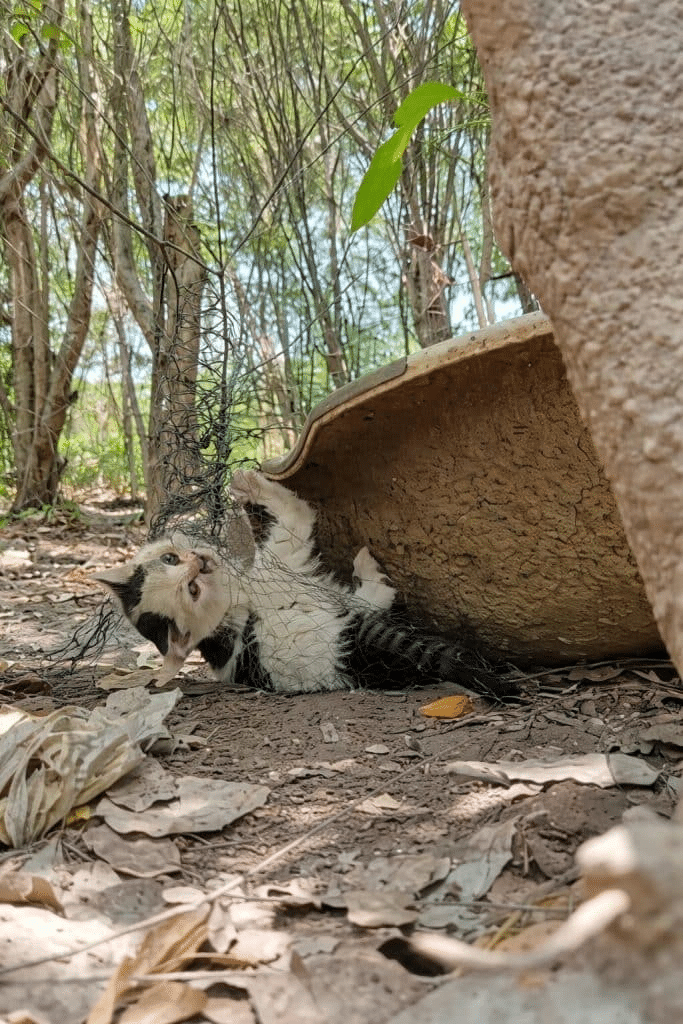
The black-and-white kitten did not remain still when someone approached.
His small body became rigid.
His ears lowered.
A loud hiss escaped from him before the unfamiliar hands had even come close.
Then came the growling.
The swiping paws.
The desperate effort to make himself look stronger than he truly was.
For such a tiny animal, his voice seemed impossibly loud.
To someone watching from a distance, the reaction might have looked like anger.
But the kitten was not angry.
He was terrified.
And fear had taken control of every movement he made.
A Small Kitten Prepared to Fight the Entire World
No one knew exactly what the kitten had experienced before help arrived.
Perhaps he had lived without gentle human contact.
Perhaps every unfamiliar sound had once warned him of danger.
Perhaps survival had taught him that allowing anyone close was simply too risky.
Whatever had happened, the lesson remained inside him.
Do not trust.
Do not relax.
Do not allow yourself to be caught.
When the rescuer stepped closer, the kitten did not see someone coming to offer safety.
He saw a threat.
His body lowered toward the ground.
His eyes widened.
He opened his mouth and hissed again.
The message was clear.
Stay away.
It was the only language fear had taught him.
The Fear Behind Every Hiss
The kitten’s reaction was not a sign that he wanted to hurt anyone.
It was an attempt to create distance.
He was small.
He had nowhere to hide.
And he did not understand what was about to happen.
So he used everything available to him.
His voice.
His teeth.
His tiny claws.
Every hiss said that he was frightened.
Every swipe asked the unfamiliar person to move farther away.
Every attempt to escape showed how desperately he wanted control over the situation.
The kitten was not trying to be difficult.
He was trying to survive.
That difference mattered.
Because once his behavior was understood as fear, the rescue could begin with patience instead of frustration.
A Rescuer Who Refused to Rush
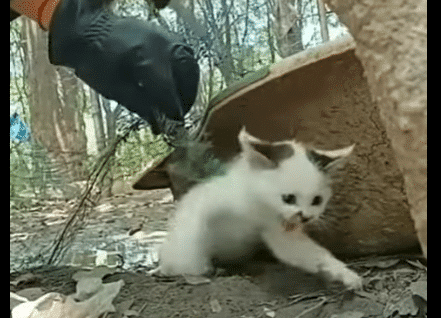
The person trying to help did not reach down with bare hands.
They understood that forcing immediate contact could increase the kitten’s panic and place both of them at risk.
Protective gloves were used.
A long-handled rescue tool allowed the person to maintain a safer distance while gently guiding the kitten away from danger.
The goal was not punishment.
It was not about overpowering him.
It was about controlling the situation without placing more pressure on a frightened animal than necessary.
Every movement was slow.
The rescuer paused whenever the kitten became more distressed.
A calm voice remained nearby.
There was no anger in the response to his hissing.
Only patience.
VIDEO: A Terrified Black-and-White Kitten Resists Every Attempt to Help Before He Is Gently Carried Into Safety
A Struggle Fueled Entirely by Fear
The kitten did not surrender easily.
When the tool moved closer, he twisted away.
When an opening appeared, he tried to escape.
His small paws pushed against the ground with all the strength they had.
He hissed.
Growled.
And reached toward anything that came near him.
Each reaction made the rescue more difficult.
But it also revealed how frightened he truly was.
The rescuer did not mistake resistance for stubbornness.
They understood that the kitten believed he was fighting for his life.
So the process remained careful.
A small adjustment.
A pause.
A quiet word.
Then another attempt.
The minutes felt long.
But rushing could undo every small step toward control.
Patience was not slowing the rescue.
Patience was making a safe rescue possible.
The Moment He Was Finally Secured
After several careful attempts, the rescuer was able to secure the kitten.
His body remained tense.
His legs continued pushing.
His voice did not become quiet immediately.
Even after being safely contained, he behaved as though danger still surrounded him.
Fear does not disappear the moment an animal leaves a difficult place.
The body may reach safety before the mind understands what has changed.
The kitten continued hissing from inside the secure space.
He watched every movement.
His breathing was quick.
But something important had already happened.
He was no longer exposed.
He no longer had to search for somewhere to hide.
And he no longer needed to protect himself completely alone.
Leaving the Frightening Place Behind
The kitten was transported to a quiet, protected environment.
The journey itself was unfamiliar.
Every new sound made him alert.
He stayed toward the back of the carrier, keeping as much distance as possible between himself and the people nearby.
No one tried to pull him out immediately.
The carrier was covered partially to reduce visual stress while still allowing fresh air to circulate.
Voices remained low.
Movements remained slow.
The kitten had spent the rescue trying to regain control.
Now, his caregivers began giving small choices back to him.
He could remain inside the carrier.
He could watch from a distance.
He could decide when he felt safe enough to move.
For the first time, no one expected trust before he was ready.
A Quiet Room With No Demands
A small recovery space had been prepared.
There was soft bedding.
Clean water.
Food placed nearby.
And a covered corner where the kitten could retreat when the open room felt overwhelming.
The carrier door was opened.
Then everyone stepped away.
The kitten did not come out.
He stayed hidden inside, his eyes fixed on the room beyond him.
That was allowed.
No hand reached in.
No one tried to drag him into the open.
The room remained quiet.
Minutes passed.
Then longer.
Eventually, the kitten leaned forward slightly.
His nose moved as he studied unfamiliar scents.
He did not leave the carrier yet.
But curiosity had begun to exist beside the fear.
That was the first quiet change.
The First Meal Offered Without Pressure
Food was placed close to the carrier entrance.
The kitten smelled it immediately.
Hunger pulled his attention toward the bowl.
Fear kept him hidden.
His caregiver sat at a distance, avoiding direct eye contact.
The room remained still.
After some time, one black-and-white paw appeared at the carrier door.
Then his head.
He looked toward the person nearby.
Nothing moved.
The kitten stepped forward and began eating.
His first bites were hurried.
Every few moments, he looked up.
The caregiver remained where they were.
No hand reached toward him.
No one removed the bowl.
The kitten returned to the food.
This meal became more than nourishment.
It was the first experience teaching him that a person could remain nearby without demanding anything from him.
Learning That Good Things Would Return
The next meal arrived.
Then another.
Fresh water remained available.
His bedding was kept clean.
The same gentle caregiver entered the room without chasing or cornering him.
At first, the kitten hissed whenever the door opened.
He moved immediately toward his hiding place.
But the person brought food.
Adjusted the room quietly.
Then left him space.
The pattern repeated.
Nothing frightening followed those footsteps.
Day after day, his response began to soften.
The hissing did not disappear completely.
But it became shorter.
He stopped retreating quite as far.
Sometimes, he remained visible while the bowl was placed down.
Trust was not arriving through one dramatic moment.
It was being built through consistency.
The First Careful Examination
The kitten needed a health assessment.
But handling him too quickly could erase the small amount of confidence he had begun to develop.
The caregivers prepared carefully.
The room remained calm.
The examination was kept as brief and gentle as possible.
His body was checked for signs of weakness, discomfort, or other concerns needing attention.
Throughout the process, the kitten remained frightened.
His muscles tightened beneath every touch.
But the hands supporting him were steady.
No one became angry when he struggled.
No one punished him for reacting.
As soon as the necessary care was complete, he was returned to his safe space.
The experience showed him something new.
Being handled could feel unfamiliar.
But it did not always end in harm.
The Distance Between Them Slowly Becomes Smaller
During the following days, the caregiver began sitting closer to the kitten’s feeding area.
Not close enough to make him panic.
Only close enough for him to become accustomed to a human presence.
At first, he refused to eat until the person left.
Later, hunger encouraged him forward while they remained in the room.
He watched them carefully.
One bite.
A glance upward.
Another bite.
Another glance.
Nothing happened.
The caregiver did not stare.
Did not move suddenly.
Did not reach toward him.
Soon, the kitten could finish an entire meal while someone sat quietly nearby.
The distance between them was still there.
But it was no longer filled only with fear.
The First Time He Chose Not to Hiss
One morning, the caregiver entered carrying food.
The kitten looked up from his bedding.
His body became alert.
But no hiss came.
He remained where he was.
The bowl was placed down.
The person stepped away.
It was a small moment.
Easy to miss.
But it meant something important.
For the first time, the kitten had seen a person approach and had not immediately felt the need to defend himself.
He was still cautious.
His eyes still followed every movement.
But fear no longer controlled the entire response.
Something else had appeared.
Recognition.
He knew this person.
He knew what the bowl meant.
And somewhere inside him, he was beginning to expect care instead of danger.
A Toy Creates a New Kind of Connection
A lightweight toy was introduced from a distance.
The caregiver moved it gently across the floor without bringing their hands too close.
The kitten watched.
His eyes followed every small movement.
At first, he did not leave his hiding place.
Then one paw reached forward.
The toy moved away.
The kitten leaned closer.
For several moments, curiosity competed with fear.
Then curiosity won.
He stepped into the open and touched the toy.
It rolled.
He followed.
The caregiver remained still except for the gentle movement of the toy.
The kitten forgot to watch them constantly.
For a brief moment, he was not defending himself.
He was playing.
That simple game became another bridge between them.
The Kitten Hidden Behind the Fear
As the days passed, a different personality began to appear.
The kitten was curious.
Observant.
And deeply interested in anything that moved.
He liked soft toys.
He investigated fresh blankets.
He watched household sounds from the safety of his bed.
The aggressive-looking behavior from the rescue had never been his true personality.
It had been a shield.
Beneath that shield was a young cat who wanted to explore.
Who wanted food and warmth.
Who wanted to play.
He simply needed enough time to believe those things could exist without danger following them.
The First Hand Offered Without Touching
The caregiver began placing a gloved hand on the floor at a comfortable distance.
It did not move toward the kitten.
It simply remained there.
The kitten watched.
Then looked away.
The next day, the hand appeared again.
Still.
Quiet.
After several sessions, the kitten approached.
He stretched his neck forward and smelled the fingers.
Then he stepped back.
No one followed him.
The hand remained where it was.
Another day, he came closer again.
This time, he stayed for a little longer.
The choice belonged to him.
That freedom made all the difference.
The First Gentle Touch
The first touch lasted only a moment.
The kitten approached the familiar hand.
He smelled it.
Then remained nearby.
One finger moved slowly and touched the side of his cheek.
His body became tense.
But he did not swipe.
He did not bite.
The hand moved away before he felt the need to defend himself.
The kitten looked toward it.
Perhaps he was surprised.
The touch had not trapped him.
It had not forced him to remain.
The next time, he allowed it again.
Then for a few seconds longer.
Trust was growing through brief, respectful moments.
Each ended before fear had the chance to take control.
Learning That He Could Walk Away
One of the most important lessons for the kitten was discovering that he could leave.
If a person sat nearby, he did not have to defend himself immediately.
He could move toward his bed.
He could retreat behind a blanket.
He could choose distance.
No one chased him.
The freedom to walk away reduced his need to fight.
Hissing had once been the only way he could create space.
Now, the environment gave him space without requiring a battle.
His body began remaining softer around people.
His ears stayed more relaxed.
His posture no longer prepared for escape every moment.
Safety was teaching him a language gentler than fear.
The First Time He Leaned Into a Hand
The change happened quietly.
The kitten approached while the caregiver sat on the floor.
A hand rested nearby.
He smelled it.
Then the fingers touched his cheek.
Instead of stepping away, the kitten leaned forward.
Only slightly.
But enough to show that the touch felt comforting.
The caregiver remained calm.
No sudden excitement interrupted the moment.
A gentle stroke moved along the side of his face.
The kitten’s eyes softened.
For perhaps the first time, he was not merely tolerating human contact.
He was participating in it.
The tiny animal who had fought every approaching hand was beginning to seek one.
A Body That No Longer Stayed Tense
During the early rescue, every part of the kitten’s body had been prepared for defense.
His back was rigid.
His paws were ready to strike.
His eyes watched for danger.
Now, he began resting differently.
He stretched on the bedding.
He groomed himself while someone remained in the room.
Sometimes, he turned his back on the caregiver.
That small action required trust.
A frightened animal protects itself by watching everything.
A safer animal can look away.
The kitten was learning that he did not need to monitor every movement.
Someone else was watching over the space now.
The First Quiet Purr
One evening, the kitten settled near his caregiver after eating.
A hand moved gently across his head.
He remained still.
Then came a faint sound.
Soft.
Almost uncertain.
A purr.
The caregiver paused, listening.
The sound continued.
It was not loud.
But it carried the weight of the entire journey.
The kitten who had once greeted people with growls and hisses was now responding to touch with comfort.
His fear had not been erased completely.
But it no longer owned every moment.
Something softer had finally found room to grow.
From Defensive to Playful
As his confidence increased, the kitten became more active.
He chased toys across the floor.
Pounced from behind blankets.
Explored corners he had once avoided.
Sometimes, he raced through the room with the sudden energy only a young kitten could possess.
His voice changed too.
The desperate growls became less common.
Ordinary meows appeared.
Small calls for food.
Curious sounds when something new entered the room.
The same energy once used to defend himself was now being used to play.
Nothing about the kitten had been broken.
He had simply needed a world where survival was no longer his only concern.
The Caregiver Who Stayed Through the Difficult Beginning
The kitten’s transformation was possible because someone remained patient when trust was not immediately offered.
The rescuer did not expect gratitude.
They did not interpret fear as rejection.
They understood that progress might be slow.
Some days, the kitten seemed more confident.
Other days, an unfamiliar sound brought the old fear back.
The caregiver accepted both.
Trust is rarely a straight path.
It grows.
Retreats.
Then grows again.
What mattered was consistency.
The person continued showing up.
Continued bringing food.
Continued respecting his boundaries.
The kitten eventually learned that this kindness was not temporary.
A Home Where He No Longer Needed Armor
The kitten’s new environment did more than protect his body.
It allowed him to lower the emotional armor he had built.
There were hiding places when he needed them.
Open areas when he wanted to explore.
Food he did not have to compete for.
And people who understood his signals.
When he moved away, they gave him space.
When he approached, they welcomed him calmly.
No one demanded affection.
That patience allowed affection to arrive naturally.
The kitten no longer needed claws and teeth to control every interaction.
He had discovered another option.
Trust.
The Fear Was Never His Whole Story
People who saw only the rescue might remember a difficult kitten.
One who hissed.
Swiped.
And fought against every attempt to help.
But those moments told only the beginning.
They revealed what fear had taught him to do.
They did not reveal who he truly was.
The real kitten appeared later.
The playful one.
The curious one.
The young cat who enjoyed gentle touch once he understood it was safe.
His defensive behavior had never made him unlovable.
It had simply shown how urgently he needed patience.
A Future Built at His Own Pace
The kitten’s journey toward confidence continued one day at a time.
There was no deadline.
No expectation that he should become affectionate immediately.
His caregivers allowed him to set the pace.
Some forms of touch became comfortable quickly.
Others took longer.
Certain sounds still startled him.
Unfamiliar visitors required more distance.
But none of those things erased his progress.
He had learned how to eat beside someone.
How to play with a human nearby.
How to approach a hand.
How to lean into affection.
And how to sleep without preparing to defend himself.
Each skill represented another piece of fear falling away.
A Gentle Reminder About Frightened Animals
A hiss is not always anger.
A swiping paw is not proof that an animal is cruel.
A bite attempt does not always mean an animal cannot learn to trust.
Often, these behaviors come from fear.
From feeling cornered.
From not understanding what is happening.
Frightened animals need safe handling, experienced support, and boundaries that protect everyone involved.
Most importantly, they need patience.
Trust cannot be forced.
It must be invited.
And that invitation may need to be offered many times before an animal feels safe enough to accept it.
What Patience Made Possible
The kitten’s rescue did not begin with a peaceful animal resting in someone’s arms.
It began with resistance.
Hissing.
Struggling.
And a little body using everything it had to keep unfamiliar people away.
But the rescuer stayed calm.
They used protective equipment.
Maintained a safe distance.
And secured the kitten without treating his fear as a personal rejection.
Then came the quieter work.
Food.
Shelter.
Respect.
Repeated kindness.
Those ordinary acts accomplished what force never could.
They taught the kitten that he no longer needed to fight.
A Gentle Reminder About Trust
Not every rescue begins with trust.
Sometimes, it begins with fear so strong that kindness cannot be recognized immediately.
Sometimes, the animal being saved will struggle against the very hands trying to help.
That does not make the life less worthy of saving.
It makes patience even more important.
This black-and-white kitten did not hiss because there was something wrong with his heart.
He hissed because he believed he was alone.
He swiped because he had no other way to ask for distance.
He resisted because survival had taught him never to surrender control.
Then someone remained long enough to teach him something different.
Food would return.
Hands could be gentle.
A safe place could remain safe tomorrow.
And closeness did not always lead to pain.
The frightened kitten who once fought every attempt to help can now rest without preparing for danger.
He can play.
Explore.
Approach familiar hands.
And allow himself to experience affection.
His journey did not begin with a trusting heart.
It began with a terrified one.
But patience stayed.
Kindness continued.
And slowly, fear made room for something softer.
A quiet purr.
A gentle touch.