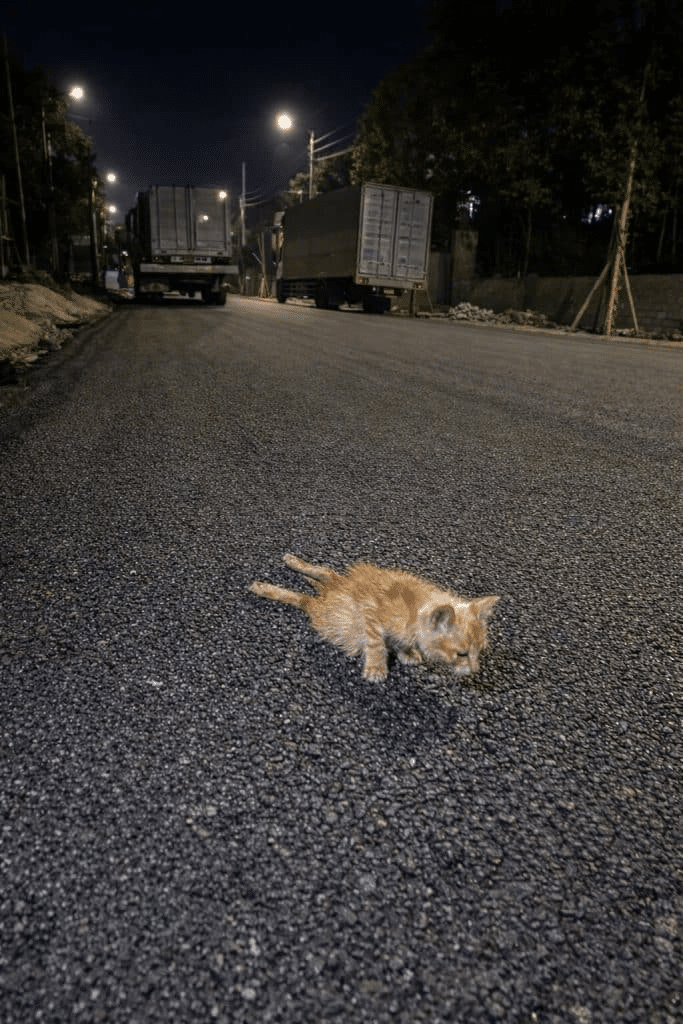
The first thing anyone saw was a small orange body lying beneath the dim light of an empty road.
The kitten barely moved.
His fur looked dusty from the asphalt beneath him, and his fragile body seemed far too small for the open space surrounding it.
There were no houses close enough to offer shelter.
No mother waiting beside him.
No safe corner where he could crawl away from the cold road.
When someone approached, the kitten did not run.
He did not even try.
His front paws shifted slightly, but his back legs remained still behind him.
All he could do was wait.
In a place where almost no one stopped, one person finally did.
And that quiet decision opened the first door toward a life filled with care, patience, and new possibilities.
A Small Life Alone on the Road
The rescuer slowed when the orange kitten came into view.
At first, it was difficult to understand why he remained so still.
A frightened kitten would usually try to hide.
Even a tired one might move toward the edge of the road.
But this little cat stayed where he was.
His eyes followed the person coming closer, yet his body did not respond in the way he seemed to want it to.
The rescuer knelt beside him.
Her movements were careful.
Her voice remained soft.
When she reached toward him, the kitten did not resist.
Perhaps he was exhausted.
Or perhaps he understood that he could not leave the road without help.
She placed one hand beneath his chest and another beneath his body, supporting him fully as she lifted him away from the asphalt.
He felt light in her arms.
Too light.
But he was alive.
And now, he was no longer waiting alone.
Leaving the Cold Asphalt Behind
The kitten was wrapped gently before being carried to safety.
For the first time, something soft rested beneath his body.
The road disappeared behind him.
The cold surface that had offered no comfort was replaced by warmth and careful hands.
During the journey, the kitten remained quiet.
His front paws moved occasionally, but his back legs stayed still.
The rescuer watched him closely, wondering what had happened and what kind of care he might need.
There were no immediate answers.
Only one clear promise:
Whatever came next, he would not face it by himself.
A Careful Examination
At the veterinary clinic, the kitten was placed on a clean examination surface.
The veterinary team approached slowly, understanding that he was both fragile and unfamiliar with everything around him.
His temperature was checked.
His breathing and heartbeat were observed.
His body was examined carefully for any signs of discomfort or injury.
Then attention turned to his back legs.
They did not respond as expected.
The kitten could move his front half, but his hind limbs offered little support when he tried to reposition himself.
The veterinary team handled him gently, checking his reactions without adding unnecessary stress.
The full road ahead was uncertain.
But the focus remained on what could be done for him now.
He needed nourishment.
Rest.
Comfort.
And time for his caregivers to understand how best to support his mobility.
VIDEO: A Tiny Kitten Found Unable to Walk Learns a Gentle New Way to Explore His World
The First Care His Body Needed
Before anything else, the kitten needed to regain strength.
Nourishing food was offered in small, manageable amounts.
Fresh water remained close.
A quiet space allowed him to rest after the examination.
He seemed tired from the journey and everything his body had endured.
Yet through each careful check, he remained calm.
He did not scratch or struggle.
He simply watched the people around him, slowly accepting the care they offered.
The veterinary team continued monitoring him and provided the support appropriate for his condition.
Nothing was rushed.
No one expected an immediate answer or a sudden recovery.
The goal was simpler.
Keep him comfortable.
Help him become stronger.
And give him every opportunity to experience a safe and meaningful life.
A Home Prepared for His Needs
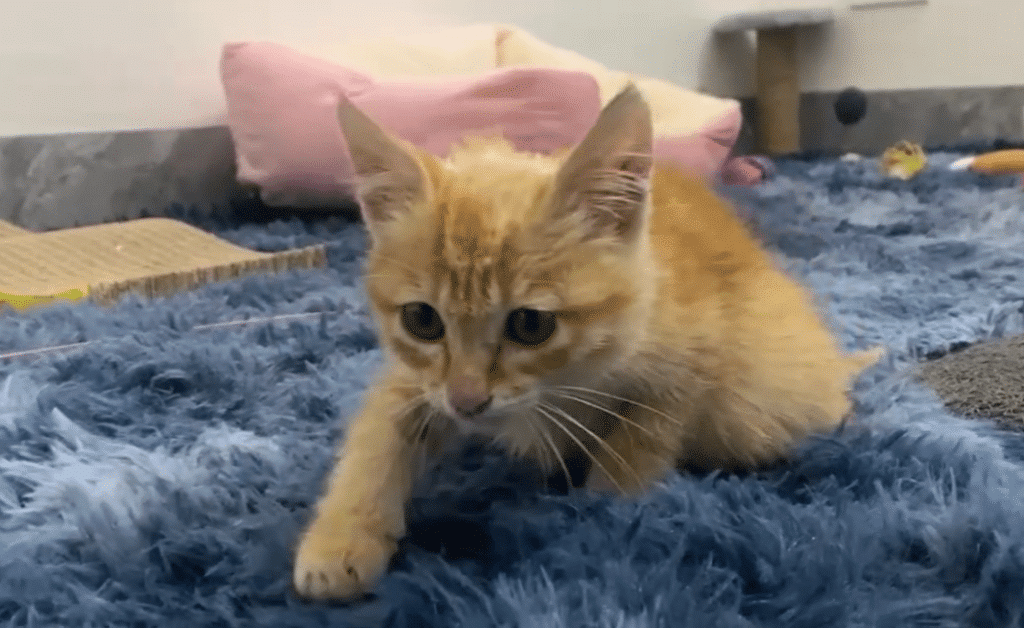
When the kitten returned home, his caregiver created a space suited to his body.
Soft bedding protected his skin and legs from hard surfaces.
Food and water were placed where he could reach them easily.
The area was kept clean, warm, and free of obstacles that might make movement more difficult.
At first, the kitten remained close to his bed.
The home was unfamiliar.
Every sound made his ears turn.
Every new object seemed to require careful study.
But no one forced him to explore.
His caregiver sat nearby and allowed him to settle at his own pace.
Meals appeared regularly.
Gentle hands helped him change position when necessary.
The soft bed remained waiting whenever he became tired.
For the first time, his surroundings were being shaped around what he needed.
He was not expected to fit into a world that ignored his differences.
The world around him was being made kinder.
The Determination Hidden Inside Him
Although his back legs could not carry him, the kitten still wanted to move.
His curiosity remained strong.
When something caught his attention, he pushed forward with his front paws.
His chest moved across the soft surface while his hind legs followed behind him.
The movement required effort.
He tired quickly.
But he continued trying.
A bowl across the room.
A familiar voice.
A small toy resting nearby.
Each one gave him a reason to move forward.
His caregiver watched carefully.
She could see that the kitten did not want to remain in one place.
He wanted to explore.
He wanted to follow.
He wanted the same freedom every young cat seemed to seek naturally.
His body needed more support.
So she began looking for a gentle way to give it to him.
A Simple Idea Made With Care
A soft support harness was created for the kitten.
It was not complicated.
But it was designed with his comfort in mind.
The material supported the back part of his body and lifted his hind legs slightly from the ground.
This reduced the weight dragging behind him and allowed his front paws to do more of the work.
The first time the harness was placed around him, the kitten looked uncertain.
The sensation was new.
His balance felt different.
His caregiver adjusted the support carefully, making sure nothing pressed too tightly against his body.
Then she placed him on a soft, open surface.
The kitten remained still for a moment.
His front paws rested beneath him.
His back legs were gently supported.
A familiar voice encouraged him forward.
He shifted his weight.
And tried.
The First Movement With Support
His first attempt was small.
One front paw moved.
Then the other.
The harness followed, keeping the back of his body from dragging heavily along the floor.
The kitten stopped after only a short distance.
Balance required concentration.
Coordination did not come naturally at first.
He looked around, uncertain about the new feeling.
His caregiver remained beside him.
There was no pressure to continue.
After a rest, he tried again.
This time, he moved a little farther.
His front paws pulled his body forward while the support kept his back legs gently lifted.
Each step looked careful.
Each movement required effort.
But he was moving in the direction he chose.
For a kitten who had once been unable to leave the road, those few feet represented something much larger than distance.
They represented possibility.
Learning One Step at a Time
Practice became part of his daily routine.
The sessions remained short so his body would not become overtired.
His caregiver placed him in the harness, checked that he was comfortable, and allowed him to move at his own pace.
At first, he struggled to turn.
Sometimes he leaned too far to one side.
Other times, his front paws moved faster than the support behind him.
Whenever he became tired, he was lifted gently and returned to his soft bed.
There was never frustration in the room.
Only encouragement.
The kitten was not expected to master everything immediately.
He was learning how to understand his body in a completely new way.
One movement.
One adjustment.
One small success at a time.
The Day He Chose His Own Direction
Then came a quiet turning point.
Until that moment, the kitten had mostly moved toward the person encouraging him.
But one day, a small toy was placed a short distance away.
His eyes fixed on it.
The toy shifted gently across the floor.
The kitten leaned forward.
His front paws moved.
The harness followed.
This time, he was not moving because someone guided him.
He was moving because he had decided where he wanted to go.
He reached the toy and touched it with one paw.
It rolled away.
The kitten followed.
His movements were still uneven.
But something had changed.
He was beginning to use the support as a path toward independence.
The device did not move him.
It simply gave him the chance to move himself.
Strength Growing in His Front Legs
As the days passed, his front legs became stronger.
They had always carried more responsibility than those of most kittens.
Now, regular movement helped him use them with increasing confidence.
He pushed himself forward more easily.
He learned how to pause without losing balance.
He began making small turns.
The distance he could travel slowly increased.
His caregiver continued monitoring him carefully, making sure his skin remained comfortable and his body received enough rest.
Support did not mean ignoring his limitations.
It meant understanding them.
Some days, he had more energy.
On others, he preferred to stay close to his bedding.
Both were accepted.
Progress was not measured by how closely he could resemble another cat.
It was measured by his comfort, confidence, and ability to participate in the world around him.
Curiosity Begins to Lead the Way
The kitten started exploring beyond his familiar resting area.
He examined the legs of furniture.
He followed sounds across the room.
He paused near windows and looked toward the light outside.
Every part of the home seemed to offer a new discovery.
Without the harness, he could still move using his front legs.
With support, he was able to travel farther and with less difficulty.
His caregiver remained nearby, ready to help if the harness shifted or if he became tired.
But she also gave him space.
He needed the freedom to make choices.
Which direction to take.
What object to investigate.
When to stop and rest.
The kitten who had once been unable to leave a dangerous road was now deciding where his own journey would lead.
Play Finds Its Way Back
A young kitten’s curiosity eventually becomes play.
For him, it began with small objects placed within reach.
A soft ball.
A lightweight toy.
Something that moved when touched.
At first, he watched carefully.
Then one paw reached forward.
The toy rolled.
His eyes brightened.
He moved after it.
The harness supported him as his front paws carried him across the floor.
He tapped the toy again and changed direction to follow.
His caregiver watched the scene with quiet happiness.
The kitten was no longer moving only as part of an exercise.
He was playing.
The difference could be seen in his expression.
He was focused.
Excited.
Fully engaged with the moment.
His back legs still did not respond normally.
But for those few minutes, the limitation was not the center of his life.
Joy was.
A Personality Emerging From the Silence
As his body grew stronger, the kitten’s personality began to appear.
He was curious.
Determined.
And affectionate in a quiet way.
He recognized his caregiver’s voice and often moved toward her.
He watched household activity with bright, attentive eyes.
He showed interest in food and responded eagerly when meals arrived.
Sometimes he wanted to explore.
Sometimes he preferred to rest close to the person who had rescued him.
He was no longer simply “the kitten who could not walk.”
He was a young cat with preferences, routines, and a growing sense of confidence.
His physical condition remained part of his story.
But it was not the only part.
There was also trust.
Play.
Comfort.
And a remarkable willingness to keep trying.
Trust Built Through Everyday Care
The bond between the kitten and his caregiver grew quietly.
She helped him into the support harness.
She checked his legs and skin.
She prepared his meals and kept his bed clean.
She lifted him when he needed help, but allowed him to move independently whenever he could.
The kitten responded through small signs.
His body relaxed in her hands.
He stayed close after exercise.
He rested peacefully beside her.
Sometimes, when she reached toward him, he leaned into the touch instead of pulling away.
Trust did not come from one dramatic moment.
It came from consistency.
The same gentle voice.
The same patient hands.
The same promise repeated every day:
You will not be left alone again.
Rest Became Part of Healing
Movement mattered.
But rest mattered too.
After exploring, the kitten returned to a soft bed prepared especially for him.
The bedding supported his body and protected the legs he could not use normally.
He stretched out comfortably.
His breathing slowed.
Sometimes, his front paws continued moving in his sleep, as though he were still chasing something from the day.
The home remained peaceful around him.
There was no cold asphalt beneath his body.
No traffic passing in the darkness.
No need to wait for someone to notice.
He could close his eyes knowing that food would return, gentle hands were nearby, and another opportunity to explore would come when he woke.
Moving Differently, Not Living Less
The kitten may never move in the same way as most cats.
His back legs continue to require support.
Some parts of daily life need adjustment.
But those differences have not taken away his desire to participate.
He still wants to follow interesting sounds.
He still reaches for toys.
He still enjoys food, affection, and warm places to rest.
His life is not empty because his movement looks different.
It is full of experiences made possible by thoughtful care.
The harness does not erase his condition.
It gives him another way to engage with the world.
His caregiver does not pretend that every day is easy.
She simply continues looking for safe, comfortable ways to help him enjoy each one.
A Home Built Around Possibility
Small changes around the home make his daily life easier.
Clear pathways allow him to move without catching the harness.
Soft surfaces protect his body.
Bowls remain within comfortable reach.
His sleeping area is easy to enter and leave.
These adjustments may seem simple.
But they give the kitten something precious.
Choice.
He can decide when to eat.
When to explore.
When to play.
And when to rest.
His condition once left him stranded on a road with nowhere to go.
Now, his environment helps him move toward whatever catches his interest.
The home does not remind him constantly of what he cannot do.
It opens space for everything he can.
The Confidence to Keep Trying
With practice, his movements became more controlled.
He learned how to use his front paws together.
He understood how his body responded when the harness supported his back.
He began moving with greater purpose.
There were still uncertain moments.
He sometimes lost balance.
He sometimes needed help turning.
But he no longer seemed surprised by difficulty.
He paused.
Adjusted.
And tried again.
That quiet persistence became one of the most moving parts of his journey.
He did not understand concepts such as disability or limitation.
He only knew there was a toy nearby.
A familiar person across the room.
A world he wanted to explore.
And he continued finding his way toward it.
A Life Filled With Care and Possibility
Today, the orange kitten eats well and rests comfortably.
His body is stronger than it was on the night he was found.
He moves using his front legs and receives gentle support when he needs it.
He plays with toys.
He explores his surroundings.
He stays close to the person whose patience helped turn movement into possibility.
His life may require more planning.
More attention.
More time.
But it is also filled with meaningful moments.
A successful journey across the room.
A paw reaching toward a toy.
A peaceful nap after play.
A kitten looking up with complete trust.
The road where he once waited is part of his past now.
He no longer lies beneath the dim light hoping someone will stop.
He has already been found.
A Future Measured in Meaningful Moments
No one can promise exactly what the kitten’s mobility will look like in the future.
His caregivers continue focusing on his comfort and quality of life.
They pay attention to what helps.
They adjust when necessary.
And they celebrate progress without demanding perfection.
His journey is not about becoming the same as every other cat.
It is about helping him live safely and fully within the body he has.
Some days may bring new skills.
Others may be quieter.
But each day gives him food, warmth, companionship, and a reason to remain curious.
That is its own kind of success.
A Gentle Reminder About Strength and Love
Not every life follows the same path.
Some animals run forward easily.
Others need support beneath them.
Some progress appears in leaps.
Other progress comes one careful movement at a time.
This kitten’s story reminds us that compassion does not require us to fix everything.
Sometimes, it asks us to meet a life exactly where it is.
To provide comfort.
To create new possibilities.
To remain patient when progress is slow.
And to recognize that moving differently does not mean living less.
The orange kitten once had no way to leave the cold road on his own.
Then someone lifted him.
Someone searched for a way to support his body.
Someone stayed beside him while he learned.
Now, his front paws carry him toward toys, meals, affection, and every small discovery waiting inside his home.
He may always need a little more help.
But he is safe.
He is loved.
And in his own determined way, he continues moving forward—
one step,
one moment,
and one hopeful day at a time.