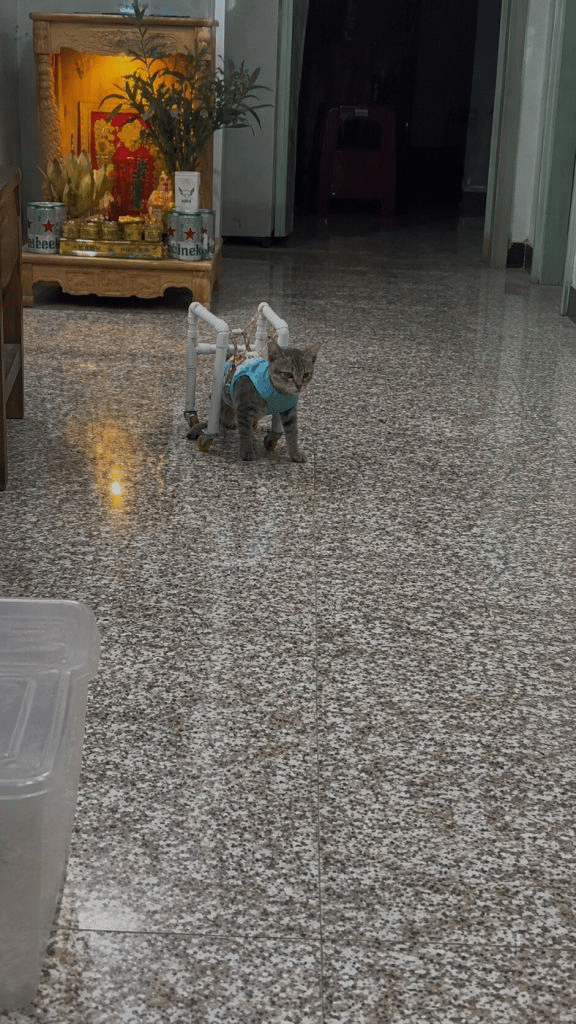
When the young cat first arrived at the veterinary clinic, everyone could see something was wrong.
His back legs were weak and unresponsive.
Instead of walking normally, he pulled himself forward using only the strength of his front legs. Every movement required effort. Even crossing a small room seemed exhausting for his small body.
For the people who loved him, it was heartbreaking to watch.
But this was not the end of his story.
It was the beginning of a journey filled with questions, determination, and hope.
Searching For Answers
The veterinary team understood that hind-leg weakness or paralysis can have many different causes.
Before any treatment plan could begin, they needed to understand what was happening inside his body.
The examination started carefully.
His reflexes were tested.
His back legs were gently moved.
The veterinarians watched closely for every reaction.
A small twitch.
A slight pull.
A tiny response to stimulation.
Every movement mattered.
Because every response provided valuable clues about what his body was still capable of doing.
VIDEO: A Young Cat Begins His Journey Toward Recovery
One of the first things his family learned was that hind-leg paralysis is often not a diagnosis by itself.
It is usually a symptom of something deeper.
Spinal injuries.
Neurological conditions.
Inflammation.
Circulation problems.
Trauma.
Many different conditions can affect a cat’s ability to walk.
That is why a proper veterinary evaluation is so important.
Finding the real cause would help determine the best path forward.
And for this little cat, every possibility was worth exploring.
A Recovery Plan Built On Patience
Once the examinations were complete, the veterinary team created a rehabilitation program designed specifically for him.
The road ahead would not be easy.
It would require patience.
Consistency.
Daily commitment.
And a family willing to stand beside him through every step of the process.
But there was hope.
Because despite his condition, he still had something powerful on his side:
people who refused to give up on him.
Small Exercises With A Big Purpose
Physical therapy quickly became part of his daily routine.
His back legs were gently stretched.
His joints carefully flexed.
Controlled movements helped support circulation and reduce stiffness while protecting muscle health.
To an outside observer, the exercises may have seemed simple.
But recovery is often built on simple things.
A careful stretch.
A few minutes of movement.
A gentle rehabilitation session.
Repeated day after day.
Little by little, these routines helped prepare his body for every opportunity to improve.
Additional Therapies Bring New Hope
Alongside physical rehabilitation, he received supportive treatments aimed at improving comfort and encouraging better nerve and muscle function.
Some sessions focused on stimulation and mobility.
Others concentrated on helping his body remain as strong and healthy as possible during recovery.
Combined with medication, monitoring, and attentive veterinary care, these treatments created the best possible environment for healing.
More importantly, they gave his family something they desperately needed.
Hope.
Hope that his body would respond.
Hope that progress would come.
Hope that his future could still be bright.
The Work Continued At Home
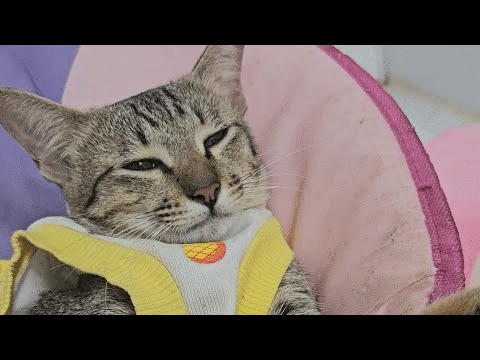
Recovery did not end when he left the clinic.
In many ways, it was only beginning.
At home, his caregivers followed every recommendation carefully.
They provided a safe and comfortable place to rest.
They monitored his appetite.
They helped maintain his hygiene.
They continued therapy exercises and watched closely for changes.
For cats facing mobility challenges, these daily routines are incredibly important.
Every meal matters.
Every therapy session matters.
Every moment of comfort matters.
Behind each routine was a simple message:
You are not alone.
A Family That Chose Patience
Perhaps the most inspiring part of his story wasn’t the medical treatment.
It was the dedication surrounding him.
Recovery can be emotionally difficult.
Some days bring visible progress.
Other days feel uncertain.
But his family kept showing up.
They learned to celebrate the smallest victories.
A stronger movement.
A better posture.
A little more balance.
A sign that he was still trying.
Those moments became powerful reminders that healing often happens quietly.
Not through miracles.
But through consistency.
More Than A Medical Case
This young cat was never simply a patient.
He was a life worth fighting for.
Even when his back legs were weak, his spirit remained strong.
He still enjoyed comfort.
He still responded to affection.
He still deserved every opportunity to heal and thrive.
Animals facing mobility challenges often teach us something remarkable.
Strength is not always measured by how fast someone runs.
Sometimes strength is found in persistence.
In trying again after a difficult day.
In continuing forward despite uncertainty.
A Future Built On Hope
Every recovery journey is different.
Every diagnosis is unique.
And every outcome follows its own path.
But stories like this remind us that mobility challenges do not automatically mean the end of a happy life.
With veterinary care.
With rehabilitation.
With patience.
With love.
Many animals continue to improve and enjoy meaningful lives.
For this brave young cat, the road ahead may still be long.
There may be more therapy.
More exercises.
More challenges to overcome.
But he no longer faces those challenges alone.
He has a veterinary team searching for answers.
He has caregivers supporting him every day.
And most importantly, he has people who believe he is worth every effort.
Because sometimes healing comes from more than medicine.
Sometimes it comes from gentle hands.
Patient hearts.
Quiet determination.
And the simple decision to never stop believing.
For this young cat, that belief may be the most powerful gift of all.