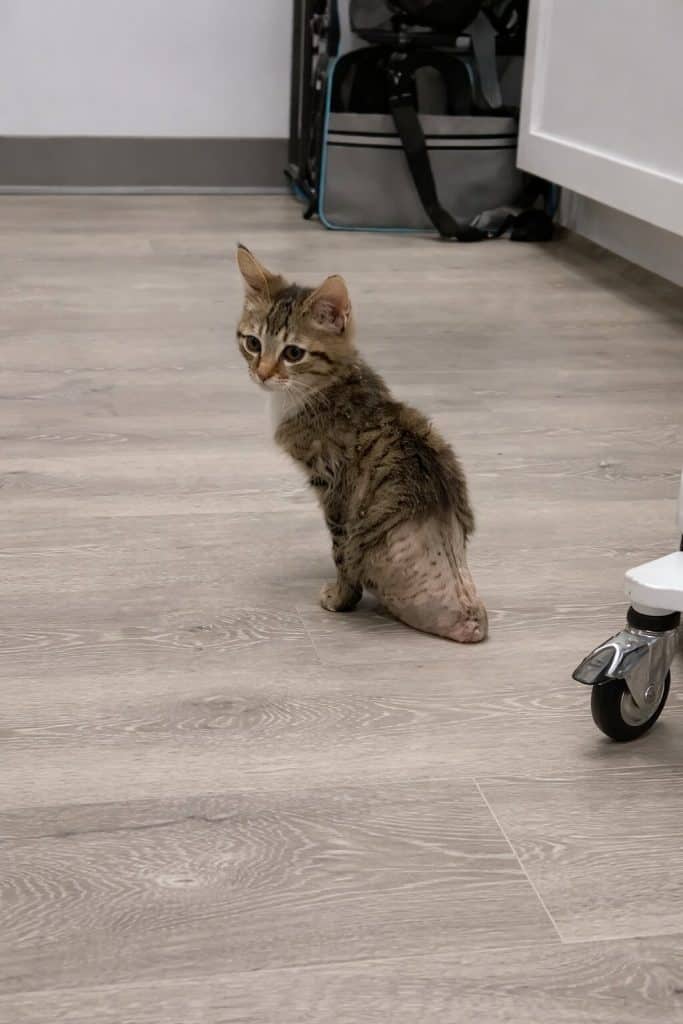
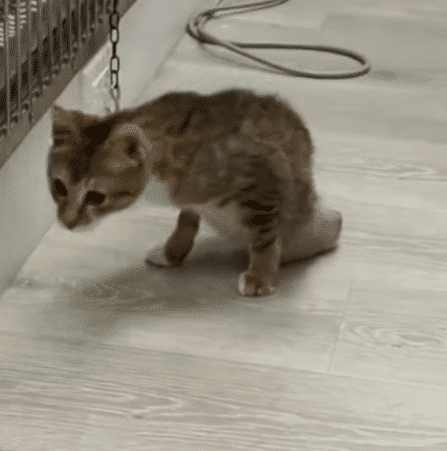
At first glance, you notice his beautiful brown-and-gray tabby fur. Then you notice how he moves. The lower half of his body doesn’t respond the way it should. His hind legs appear paralyzed — or possibly affected by a congenital condition — leaving him unable to stand or walk in the usual way. When he moves, he pulls himself forward, dragging his back legs gently along the floor.
The fur on his lower body has been shaved or worn thin, exposing soft skin that requires careful protection. And yet… he is one of the most curious kittens in the room.
Moving in His Own Way
Instead of giving in to limitation, he has mastered adaptation. His front legs are strong — surprisingly strong for such a small kitten. With determined little pulls, he glides across the floor, navigating corners and furniture with impressive speed. He doesn’t hesitate at thresholds.
Video Born Unable to Use His Back Legs — Watch This Brave Kitten Explore the World Anyway
He doesn’t avoid new spaces. In fact, he seems eager to explore them. At one point, he even attempts to climb partway up a metal enclosure, gripping with his front paws, testing his strength and balance. He may move differently. But he moves with purpose.
Energy That Outshines Limitation
There is no sadness in his expression. No frustration. Only curiosity. He investigates new scents. He approaches people confidently. He pauses only long enough to gather momentum before pulling himself forward again.
Kittens like him remind us that mobility is not defined by symmetry — it’s defined by spirit.
Affection Comes Easily to Him
Perhaps most touching of all is his personality. He is friendly. He approaches the people around him without fear. When hands reach down, he leans into them. He welcomes gentle strokes and responds with relaxed posture and bright eyes.
He does not hide. He does not withdraw. He engages. It’s not about what he lacks. It’s about what he radiates.
Living Fully, Just Differently
A kitten with hind-leg paralysis or congenital deformity requires thoughtful care:
- Soft, clean surfaces to protect sensitive skin
- Monitoring to prevent pressure sores
- Assistance with hygiene when necessary
- Regular veterinary evaluation
But beyond physical support, he needs what every kitten needs: stimulation, affection, and a safe space to grow. And he already has something many animals struggle to regain — joy.
More Than His Condition
He may drag his lower body. He may never run the way other cats do. But he is active. He is social. He is deeply alive. Watching him explore reminds you of something simple and powerful: limitations may shape the way a life moves — but they do not define how brightly it shines.