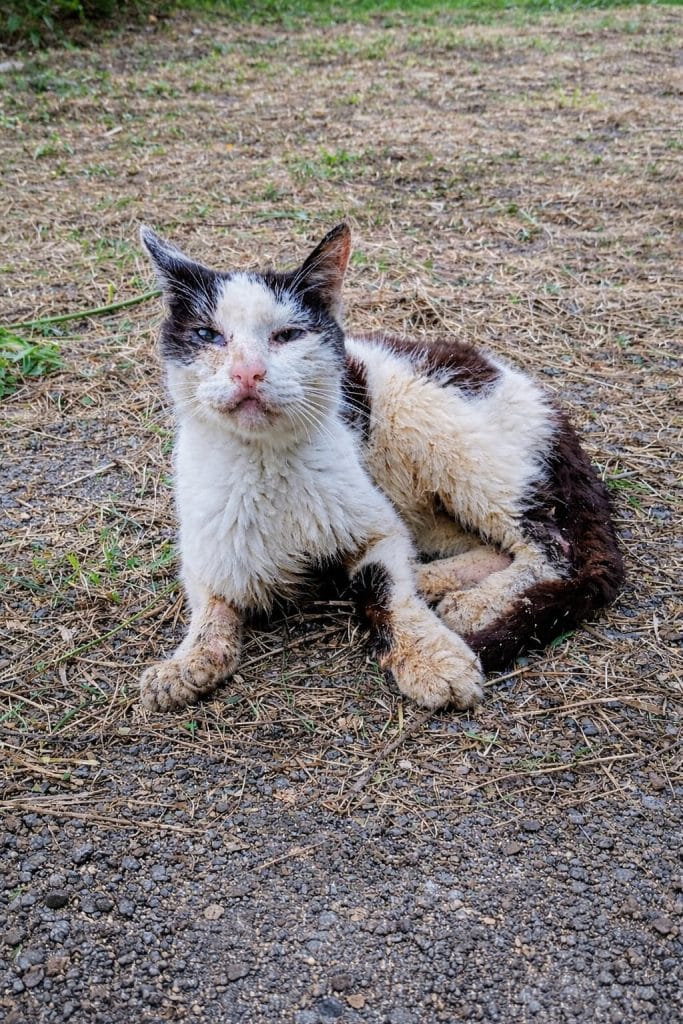
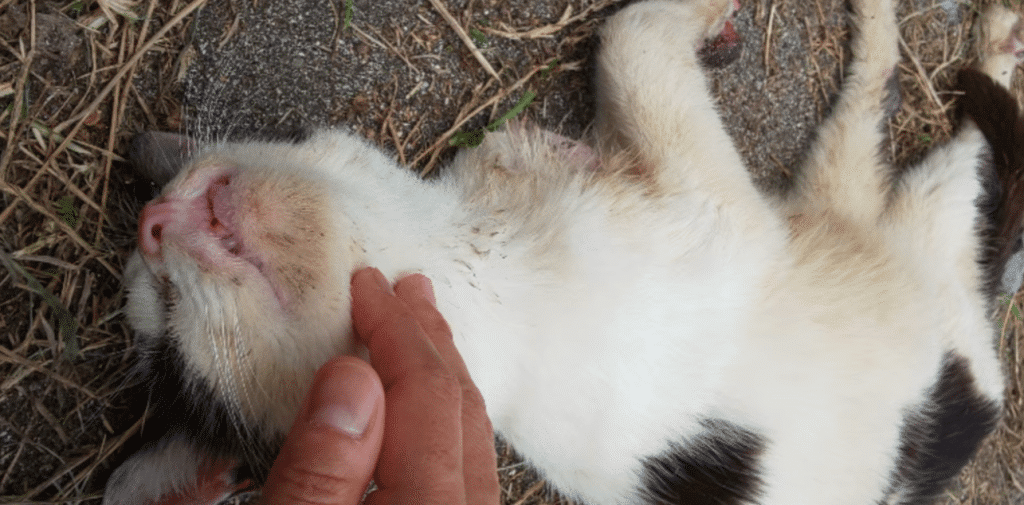
When Ohagi was first discovered, it was impossible to look at him without feeling a deep ache in the heart. He was painfully thin, with dirty, matted fur. The hair on his chest had completely fallen out, revealing fragile skin underneath. His eyes were filled with discharge, and his mouth remained slightly open due to the absence of teeth.
He did not look beautiful, but he was gentle. He leaned into touch, following people with quiet devotion. All he wanted was to be close to others.
A Hidden, Serious Wound
Not long after his rescue, something alarming was discovered. Ohagi’s front paw had become severely swollen, with cracked, ulcerated skin packed with dirt and dried leaves. Walking was clearly painful, and each step seemed like a tremendous effort.
This situation was not just a result of neglect.
Video Ohagi’s Fight — From “No Hope” to a Second Opinion
It was suffering.
A Rescuer Already Carrying So Much
At that time, the rescuer was already overwhelmed. Three small kittens needed constant care, and Shachi, the family cat, was battling leukemia. When Shachi eventually passed away and the kittens found loving homes, the house grew quieter.
That was when the rescuer could turn full attention to Ohagi.
Two Very Different Diagnoses
A couple who knew the rescuer kindly offered to take Ohagi to a veterinary clinic for an examination. The verdict was devastating: the doctor stated it would be “palliative care only.” In other words, antibiotics to ease discomfort, but no expectation of real recovery—just a quiet wait for the inevitable.
However, something inside the rescuer refused to accept that diagnosis. Ohagi was taken to another veterinarian, someone trusted and familiar. This time, the words were different.
“This is not just palliative. He can be treated.” Those words changed everything.
The Real Diagnosis
Ohagi tested positive for FIV (feline immunodeficiency virus). His right eye had limited vision, but the severe paw wounds and skin inflammation were treatable. They were not a death sentence.
He was admitted to the hospital for close monitoring and dedicated care. His wounds were properly cleaned, medication was adjusted, and his fragile body was supported.
Love in the Hospital Room
Even during his hospitalization, Ohagi’s personality shone through. Whenever the rescuer came to visit, he leaned forward eagerly, pressing close and seeking comfort. Despite all he had endured, he still trusted.
That quiet trust became the strongest reason to keep fighting for him.
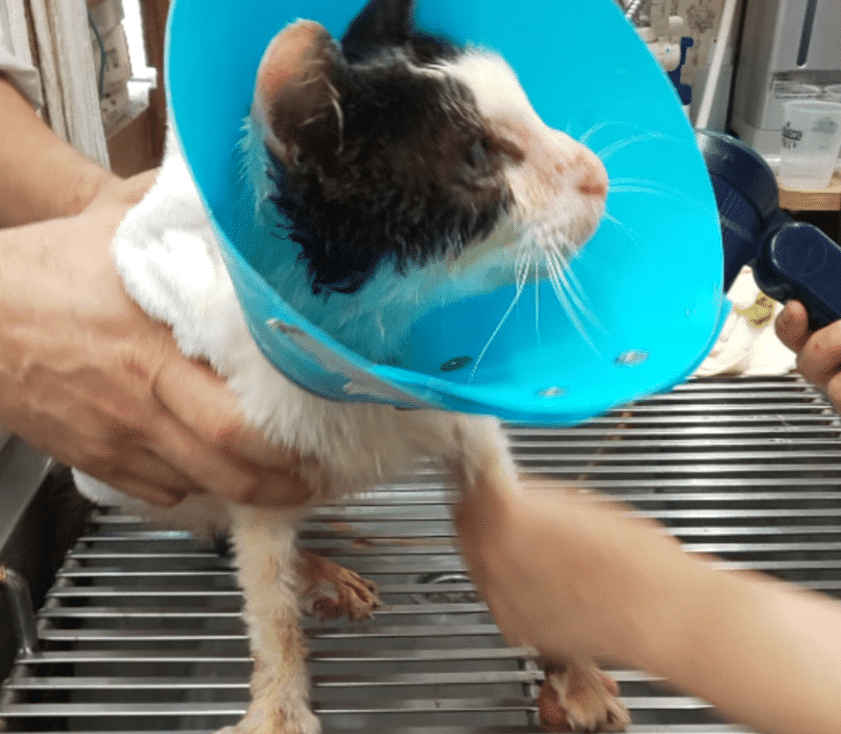
His journey is not over. Recovery will take time, as FIV requires careful management, and his body needs patience and protection. But now, he has something he did not have before: hope.
Ohagi is beginning a long battle toward healing, and this time, he is not fighting alone. Thank you for watching and caring about stories like his. Please share your thoughts in the comments.
Sometimes, all it takes is one second opinion—and one person who refuses to give up—to turn “no hope” into a new beginning.