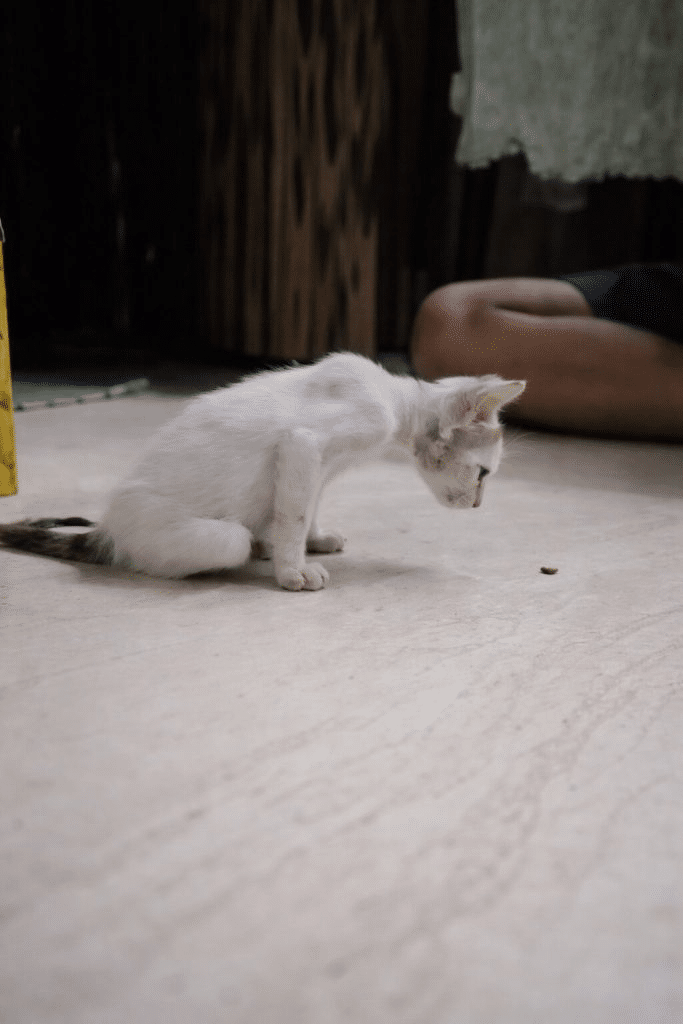
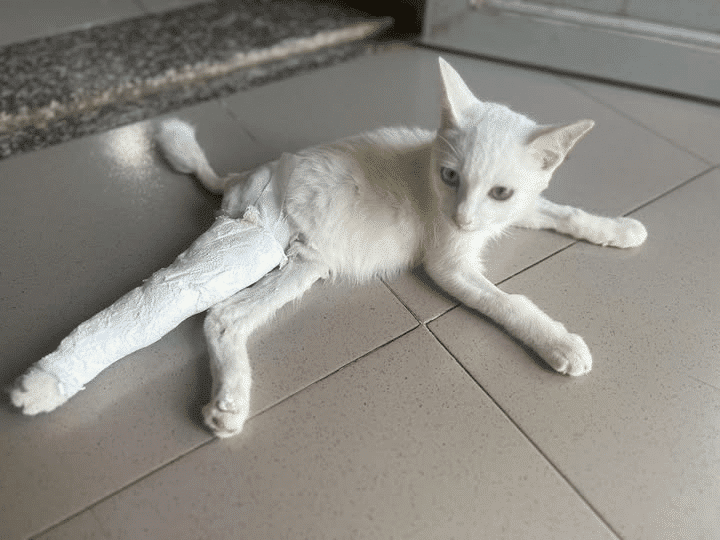
The first thing anyone noticed was how carefully the tiny white kitten tried to move.
He placed his front paws against the floor.
Pulled his body forward.
Then paused to gather enough strength for another attempt.
His hind legs remained stretched quietly behind him.
They could not support his weight.
They did not follow the way he expected them to.
Every short distance required effort.
Every movement looked slow and uncertain.
Still, the kitten kept trying.
One small pull at a time.
A Little Body Facing a Difficult Challenge
No one could understand the full cause of his mobility problem simply by watching him.
His weak hind legs and limited coordination suggested that something deeper might be affecting the way his body responded.
It could involve his nerves, muscles or another medical condition requiring professional evaluation.
What was clear was that movement did not come naturally to him.
While other kittens might have crossed the room in seconds, he needed time to travel only a few inches.
He could not easily stand.
He could not keep his back legs beneath him.
And when his front paws became tired, his entire journey had to stop.
Yet there was still curiosity in his eyes.
He watched the people nearby.
He noticed the food placed ahead of him.
And somewhere beneath the physical struggle remained a quiet desire to move forward.
Encouragement Without Force
One caregiver stayed close to the kitten.
There was no attempt to push his body into a position it was not ready to hold.
No one pulled his legs or demanded that he move faster.
Instead, they chose something gentle.
A small portion of food was placed within sight, just far enough away to invite him forward without overwhelming him.
The kitten looked at it.
Then he looked down at the distance between them.
He placed one front paw ahead.
Pulled.
Rested.
Then tried again.
The food was not used to pressure him.
It was simply a familiar comfort waiting at the end of each small effort.
A reason to lift his head.
A reason to attempt one more movement.
And each time he reached it, he was reminded that progress—however slow—could lead somewhere good.
VIDEO: A Kitten With Weak Hind Legs Takes Small Steps Forward With Patient Support
Understanding What His Body Needed
The kitten’s condition required more than encouragement alone.
He needed a proper veterinary assessment to understand what might be affecting his movement and whether any underlying problem could be treated.
Caregivers paid attention to the way he positioned his legs.
They observed how much strength he had in his front paws.
They watched for signs of discomfort, skin irritation or fatigue.
For animals with limited mobility, even ordinary daily activities may require thoughtful adjustments.
The floor needs to be safe.
Bedding should remain clean and soft.
Food and water must be easy to reach.
Any areas of the body that drag against the ground need to be checked carefully.
The goal was not to make the kitten move like every other cat immediately.
It was to protect his comfort while helping him use the abilities he still had.
A Supportive Routine Begins
With professional guidance, a consistent care routine was introduced.
The kitten received suitable nutrition to support his growing body.
Any supplements intended to support his nerves or general health were given only in carefully measured amounts as directed by those overseeing his care.
There were no promises of instant change.
No expectation that one product or one day of treatment would suddenly restore his movement.
Supportive care works best as part of a broader plan.
Veterinary monitoring.
Appropriate nutrition.
Gentle activity.
A safe environment.
And careful attention to how the animal responds.
For this kitten, the routine remained simple and calm.
Meals at regular times.
Comfortable rest.
Short opportunities to move.
Then more rest when his small body became tired.
Progress Measured in Tiny Moments
Recovery and adaptation rarely happen in a straight line.
Some days, the kitten appeared more energetic.
He pulled himself farther across the floor.
His front paws worked with greater confidence.
On other days, he needed more rest.
His movements were slower.
The distance between him and the food seemed larger.
But the caregivers did not treat slower days as failure.
The kitten’s body was still growing.
His muscles were still learning.
Every attempt required energy.
Progress could be found in many forms.
A stronger pull.
A steadier pause.
A little more control while turning.
The ability to reach his bowl without becoming as tired as before.
These changes might have seemed almost invisible to someone passing by.
To the people caring for him, they were reasons to continue believing.
Learning Through Repetition
Each day, the kitten practiced the same basic movement.
Front paws forward.
Body pulled gently behind.
Pause.
Then repeat.
With time, he began to understand his own balance more clearly.
He learned how far he could reach without tipping to one side.
He discovered how to adjust when one paw slipped.
He became more familiar with the floor beneath him and the location of the objects around him.
The movements were still different from those of other kittens.
But they were becoming less uncertain.
This was his way of navigating the world.
And as his confidence grew, the room around him began to feel larger.
A bowl was no longer impossibly far away.
A blanket became somewhere he could reach.
A familiar person could be followed, even if the journey took longer.
More Than Physical Movement
The most important change was not always visible in his legs.
It appeared in his expression.
At first, movement seemed connected only to necessity.
He traveled because food was nearby.
Because he needed a different position.
Because someone gently encouraged him.
Then curiosity began to take over.
He noticed sounds across the room.
He watched hands arranging his blanket.
He turned toward familiar voices.
A small toy caught his attention.
Even when he could not chase it quickly, he still wanted to know where it went.
That interest mattered.
It showed that the kitten was not defined only by treatment or physical exercises.
He was still a young cat.
Curious about movement.
Interested in play.
Eager to connect with the world surrounding him.
The Patience Behind Every Step
Helping the kitten required people who understood that care could not be hurried.
His body needed time.
His trust needed time.
Even a gentle routine could become tiring if too much was expected at once.
So his caregivers remained present without constantly interfering.
They encouraged him when he was ready.
They helped him when the distance became too difficult.
And they allowed him to rest without treating rest as giving up.
Patience meant recognizing the difference between support and pressure.
It meant celebrating his effort without forcing a particular result.
It meant understanding that his journey might not look like anyone else’s.
The kitten did not need to meet a deadline.
He needed a safe chance to grow.
Protecting His Comfort as He Grew
Because his hind legs dragged behind him, the kitten’s skin needed regular attention.
Repeated contact with hard flooring could cause irritation.
Soft, clean surfaces reduced unnecessary pressure.
His bedding was arranged so he could enter and leave it without facing a high edge.
Food and water remained close enough to reach but still offered gentle opportunities for movement.
As he grew, his needs could change.
He might benefit from rehabilitation exercises recommended by a veterinary professional.
He might eventually use supportive equipment.
Or he might continue developing his own effective method of movement.
The right plan would depend on his diagnosis, comfort and individual progress.
What mattered most was that every decision centered on his well-being—not on making him appear more typical.
A Kitten Who Continued to Choose Forward
The little white kitten could not understand the medical terms surrounding his condition.
He did not know why his back legs remained still.
He did not know what his caregivers hoped each new day might bring.
He only knew the world directly in front of him.
Food waiting a short distance away.
A soft voice encouraging him.
A familiar hand nearby.
So he continued doing what he had always done.
He tried.
Sometimes he reached the food quickly.
Sometimes he needed several pauses.
Sometimes the effort left him ready for a long sleep.
But each attempt carried him forward.
Not only across the floor.
Toward confidence.
Toward trust.
Toward a life in which his needs were finally being understood.
A Journey That Could Not Be Measured Overnight
There was no dramatic moment when everything changed.
No single morning when the kitten suddenly moved without difficulty.
His progress was quieter than that.
It lived inside repeated routines.
Small meals.
Carefully measured support.
Gentle movement.
Long periods of rest.
And people who continued showing up every day.
Some journeys ask for patience because the body heals slowly.
Others ask for patience because the body must learn a completely different way to function.
Both deserve respect.
The kitten’s value did not depend on how quickly he improved.
It did not depend on whether his movement eventually resembled that of other cats.
His life already mattered.
His effort already mattered.
What His Small Attempts Taught Everyone
Watching the kitten move changed the way people understood strength.
Strength was not always a powerful leap.
It was not always a dramatic recovery.
Sometimes strength was one tiny paw reaching forward.
A tired body following behind.
A pause.
Then another attempt.
The kitten showed that persistence can be quiet.
It can appear in movements so small they are easy to overlook.
But when those efforts are supported by patient care, they can become the beginning of greater independence.
His caregivers could not complete the journey for him.
They could only make the path safer.
Offer encouragement.
Protect his comfort.
And remain beside him while he discovered what his body could do.
A Gentle Reminder About Care
Animals with mobility difficulties do not need pity alone.
They need appropriate medical guidance.
Safe surroundings.
Consistent care.
And people willing to recognize progress in all its forms.
Some may improve through treatment and rehabilitation.
Some may always move differently.
But difference does not remove the ability to experience comfort, affection, curiosity and joy.
This kitten was not simply a patient with weak hind legs.
He was a small life learning about the world.
A kitten who enjoyed food.
Recognized familiar voices.
Watched nearby movement with interest.
And continued trying even when the journey was slow.
Still Moving Toward Something Better
The little white kitten’s future could not be predicted from one difficult day.
His body still needed evaluation, support and time.
But he was no longer facing the challenge without help.
There were people observing his needs.
People protecting his comfort.
People willing to repeat the same gentle routine for as long as necessary.
And every day, the kitten answered that care in the only way he knew.
He placed his front paws forward.
He pulled.
He rested.
Then he tried once more.
His story reminds us that meaningful progress is not always measured by how far someone travels.
Sometimes it is measured by the courage to begin again.
By the care that remains when improvement is slow.
And by one tiny kitten who continues moving toward hope—one determined effort at a time.